
 Nayan Dhumal
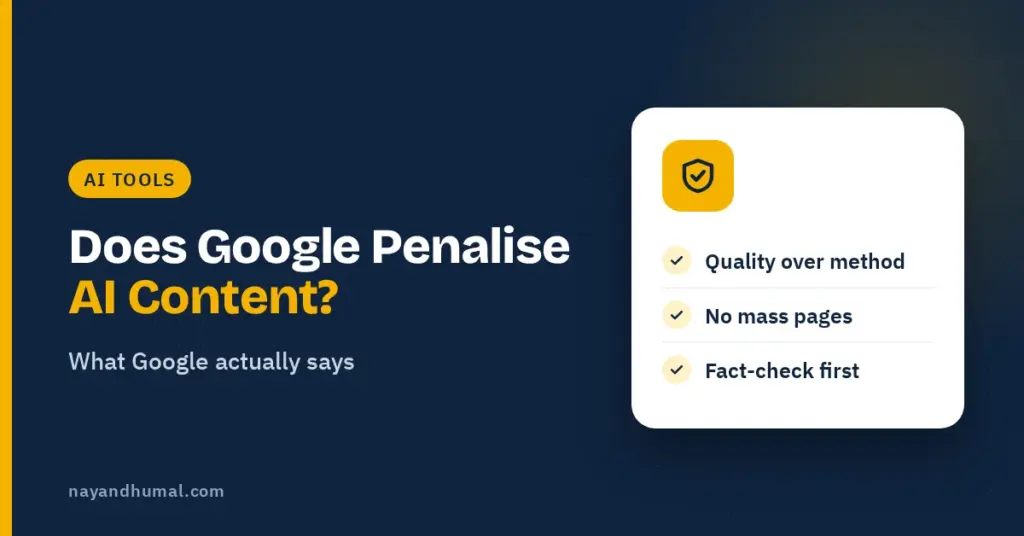
No, Google does not penalise content just because AI helped write it. Google’s guidance, published on 8 February 2023, says its focus is “on the quality of content, rather than how content is produced”, and that “Appropriate use of AI or automation is not against our guidelines.” What Google does act against is using AI, or any automation, to mass-produce pages mainly to manipulate rankings. This guide explains what Google actually says and how to use AI safely on a blog.
“Will Google punish my blog if I use ChatGPT?” is one of the most common questions new bloggers ask. The fear usually comes from rumours, not from Google’s own documents.
The good news is that Google has written clearly about this. The rules are about quality and intent, not about which tool you used.
Key takeaways
- Google says appropriate use of AI is not against its guidelines.
- Google rewards helpful, high-quality content however it is produced.
- Mass-producing pages with AI without adding value can break Google’s spam policies.
- Google asks creators to fact-check and review AI content before publishing.
- The same review applies to titles, meta descriptions and alt text.
- Your experience and checking are what make an AI-assisted post useful.
What Google says about AI content
Google explained its position in a Search Central blog post called Google Search’s guidance about AI-generated content. The main points are:
- Google’s focus is on the quality of content, not how it was made.
- Appropriate use of AI or automation is not against Google’s guidelines.
- Using automation, including AI, with the primary purpose of manipulating search rankings is a spam violation.
- Creators should think about the “Who, How and Why” of their content.
Google’s newer page on using generative AI content (last updated 1 October 2026) adds practical advice: focus on accuracy, quality and relevance, and review AI output before you publish it.
Where AI content does get into trouble
Google’s spam policies include a section on scaled content abuse. It describes generating many pages “for the primary purpose of manipulating search rankings”, and lists “Using generative AI tools or other similar tools to generate many pages without adding value for users” as an example.
| Usually fine | Likely to cause problems |
|---|---|
| AI helps you outline, then you write and check | Hundreds of AI pages published with no review |
| AI drafts a section you then fact-check and improve | Rewritten copies of other sites’ articles |
| AI suggests titles and you pick and edit one | Pages made only to target keywords, with nothing useful |
| AI summarises your own notes or research | Unchecked facts, prices or medical claims |
The simple test
Ask yourself: would this post still be worth publishing if search engines did not exist? If the answer is yes, how you drafted it matters far less.
Why fact-checking matters
Google’s generative AI page points out that AI models predict likely words rather than look up facts, so their output can be wrong. That is why Google asks creators to manually check AI content before publishing.
For a blog, this means:
- Check every number, price, date and claim against an official source.
- Remove anything you cannot verify.
- Add what only you can add: your examples, screenshots and opinions.
My blog post editing checklist works well as a final pass on AI-assisted drafts.
Metadata counts too
Google says the same review applies to metadata that can appear in search results, such as title elements, meta descriptions, structured data and image alt text. If AI writes your meta description or alt text, read it before you save it.
How to use AI safely on your blog
- Start with a real question your readers ask, not just a keyword.
- Use AI for the slow parts: outlines, first drafts, summaries and idea lists.
- Check every fact against official sources.
- Add your experience and examples so the post is genuinely helpful.
- Publish at a pace you can review. Quality beats volume.
This fits Google’s idea of helpful content and E-E-A-T: experience, expertise, authoritativeness and trust.
Frequently asked questions
Does Google penalise AI-generated content?
Not for being AI-generated. Google says appropriate use of AI is not against its guidelines. It acts against content made mainly to manipulate rankings.
Can I use ChatGPT to write blog posts?
Yes, as a helper. Review, fact-check and improve what it writes before you publish.
Do I need to say a post was written with AI?
Google says sites can help readers by explaining how content was created, including how automation was used. A short note is a simple way to do that when AI played a major role.
What is scaled content abuse?
Generating many pages mainly to manipulate rankings, including with AI tools, without adding value for users.
Can AI write my meta descriptions?
Yes, but Google says metadata should be reviewed like any other AI output.