
 Nayan Dhumal
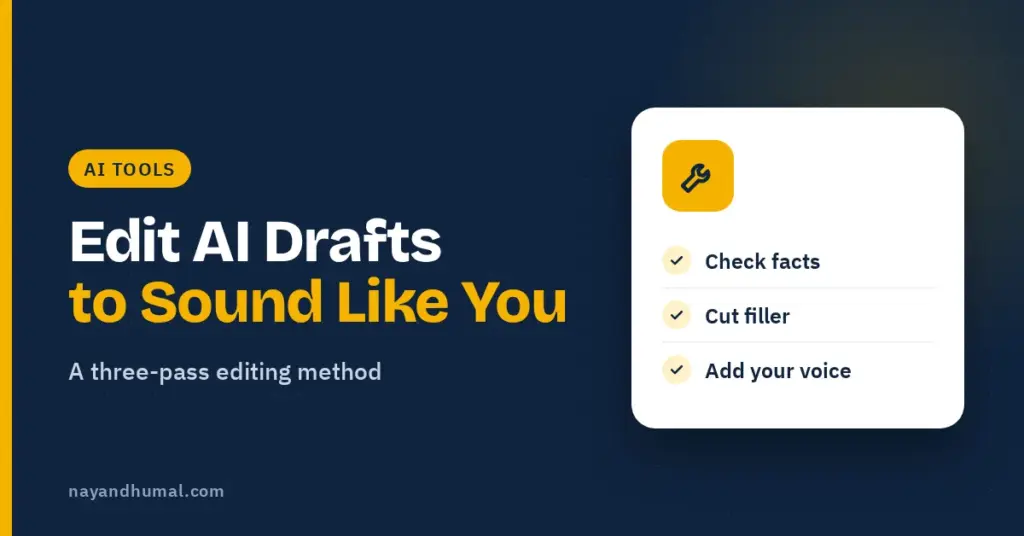
To make an AI-written draft sound like you, edit it in three passes: first check every fact, then cut the generic filler, then rewrite key parts in your own voice with your own examples. Reading the draft aloud and replacing vague phrases with specific details does most of the work. This guide gives a practical editing process and a list of common AI habits to remove.
An AI draft can save time, but publishing it as it is usually shows. The sentences are smooth but empty, the examples are generic and the tone sounds like no one in particular.
Editing turns a draft into a post your readers trust. It also matches Google’s advice to review AI content for accuracy and quality before publishing.
Key takeaways
- Check facts before you polish the writing.
- Cut filler phrases and repeated points.
- Replace generic examples with your own.
- Write the opening and ending yourself.
- Read the post aloud to catch phrases you would never say.
- Keep a short list of your own style rules and reuse it.
Pass 1: check the facts
Start here, because there is no point polishing a sentence that is wrong.
- Highlight every number, price, date, name and claim.
- Check each one against an official or primary source.
- Delete anything you cannot verify.
- Update anything that may have changed since the AI’s training data.
Pass 2: cut the filler
AI drafts often include phrases that add length but not meaning.
| Common AI habit | What to do instead |
|---|---|
| Long introductions that repeat the title | Answer the question in the first paragraph |
| “In today’s digital world…” openers | Start with the reader’s problem |
| Lists of three for everything | Keep only the points that matter |
| Vague advice like “stay consistent” | Say exactly what to do and how |
| Same idea repeated in the conclusion | End with one clear next step |
My guide on writing posts people finish reading has more on tight structure.
Pass 3: add your voice and experience
- Write the hook yourself. See how to write a blog post hook.
- Swap in your examples: your screenshots, your results, your mistakes.
- Use the words you actually use when explaining this to a friend.
- Add opinions. Say what you would choose and why.
- Vary sentence length. Mix short sentences with longer ones.
Read it aloud
If a sentence feels strange to say out loud, rewrite it. This one habit removes much of the stiff, generic tone in AI drafts.
Give the AI better instructions next time
Better input means less editing:
- Paste a paragraph you wrote and ask it to match the tone.
- Give it your notes and examples instead of asking it to invent them.
- Tell it what to avoid, such as long introductions or certain phrases.
- Ask for one section at a time, not the whole post.
Keep a short style note, such as “British spelling, short paragraphs, no hype words”, and paste it at the start of each session.
A final checklist
- Every fact checked against a source.
- Opening answers the question quickly.
- At least one real example or screenshot.
- No filler phrases or repeated points.
- Title and meta description reviewed.
- Internal links added. See how to add internal links.
For the full pre-publish routine, use my blog post editing checklist.
Frequently asked questions
How do I make AI writing sound more human?
Check facts, cut filler, add your own examples and opinions, and read the post aloud to rewrite anything that sounds unnatural.
Should I rewrite the whole AI draft?
Not always. Focus on the opening, examples and conclusion, and edit the rest for clarity and accuracy.
Do AI detectors matter for SEO?
Google’s focus is on whether content is helpful and accurate, not on how it was produced. See what Google says about AI content.
How long should editing an AI draft take?
It depends on the topic. Fact-heavy posts take longer because every claim needs checking.
Can AI copy my writing style?
It can imitate a sample you give it, but you will still need to edit the result.