
 Nayan Dhumal
A hook is the first sentence or two of your blog post, and its only job is to make the reader keep going. The best hooks name the reader’s problem, promise a clear payoff and get to the point fast. This guide covers seven simple hook types, examples for each and the mistakes that make readers leave before the first heading.
Most readers decide in a few seconds whether a post is worth their time. They glance at the opening, maybe scroll a little, and either settle in or hit the back button.
You do not need clever writing to keep them. You need an opening that tells them they are in the right place.
Key takeaways
- The hook is your first one to three sentences.
- A good hook confirms the reader is in the right place and promises a payoff.
- Answer or preview the main question early.
- Keep the first paragraph short.
- Avoid long backstories, dictionary definitions and “In today’s world” openings.
- Write the hook last, once you know what the post delivers.
What a hook needs to do
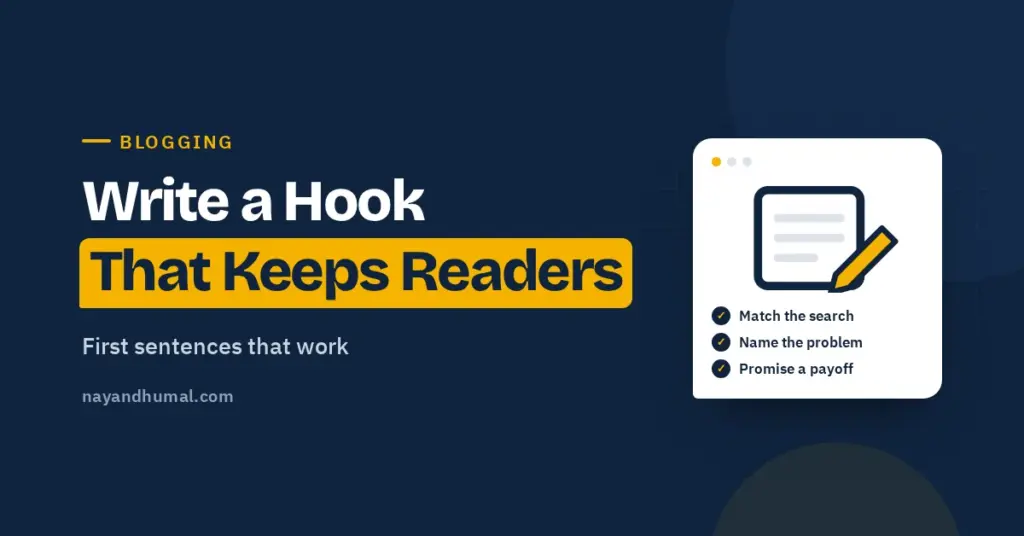
A strong opening does three things:
- Matches the search. The reader should instantly see the post is about what they searched for.
- Shows you understand the problem. Name the situation they are in.
- Promises a payoff. Tell them what they will be able to do by the end.
If your opening does those three things, the reader has a reason to keep scrolling.
7 hook types you can use
1. The direct answer
Give the short answer first, then promise the detail.
Example: “The right length for a blog post is whatever it takes to answer the question fully. Google says it has no preferred word count. Here is how to decide for your post.”
This works especially well for “what is” and “how long” searches. It is the style used on most posts on this blog.
2. The problem statement
Describe the reader’s situation in their own words.
Example: “You published ten posts, checked Search Console, and saw almost nothing. That is normal for a new blog, and it is fixable.”
3. The surprising fact
Open with a fact that changes how the reader sees the topic. Only use facts you can source.
Example: “Google says it does not accept payment to rank a site higher. So how do the top results get there?”
4. The question
Ask the question the reader is already asking themselves, then answer it.
Example: “Should you use categories or tags in WordPress? Both, but for different jobs.”
5. The before and after
Show where the reader is now and where the post will take them.
Example: “Right now your blog has posts. By the end of this guide, it will have a clear structure that readers and Google can follow.”
6. The mistake
Point to a common mistake the reader might be making.
Example: “Most new bloggers leave image alt text empty. It takes ten seconds to fix and helps both accessibility and SEO.”
7. The short story
A one or two line personal moment, only if it is true and relevant.
Example: “When I deleted old posts without redirects, Google kept finding pages that no longer existed. Here is how to avoid that.”
Keep stories very short. A long backstory before the answer is one of the main reasons readers leave.
Pro tip
Write your hook last. Once the post is finished, you know exactly what it delivers, and the opening becomes much easier to write.
Hooks to avoid
- “In today’s digital world…” It says nothing and delays the point.
- Dictionary definitions. “According to the dictionary, a blog is…” Readers already know.
- Long personal backstories. Save details for later in the post, if at all.
- Clickbait the post cannot deliver. If the opening promises more than the post gives, readers feel misled.
- Questions with obvious answers. “Do you want more traffic?” Everyone does.
After the hook: keep the momentum
The hook gets the first few seconds. The next part keeps the reader:
- Keep the first paragraphs short, one to three sentences each.
- Add a short summary or key takeaways box near the top.
- Use clear headings so readers can scan.
- Deliver the main answer early, then add depth.
My guide on writing a blog post people finish reading covers the rest of the structure.
Hook, title and meta description work together
The title gets the click in search results. The meta description supports it. The hook confirms the reader made the right choice. If all three promise the same thing, readers are more likely to stay. My guide on writing blog post titles explains the first part.
Frequently asked questions
What is a hook in a blog post?
It is the opening sentence or two, written to make the reader keep reading.
How long should a blog post hook be?
Usually one to three sentences. Short openings work better than long introductions.
Should I start with a question?
It can work if it is the question the reader is really asking. Avoid questions with obvious answers.
Should the hook include the keyword?
It helps if it fits naturally, because it confirms the post matches the search. Do not force it.
When should I write the hook?
Many writers find it easier to write the hook last, once the post is complete.