


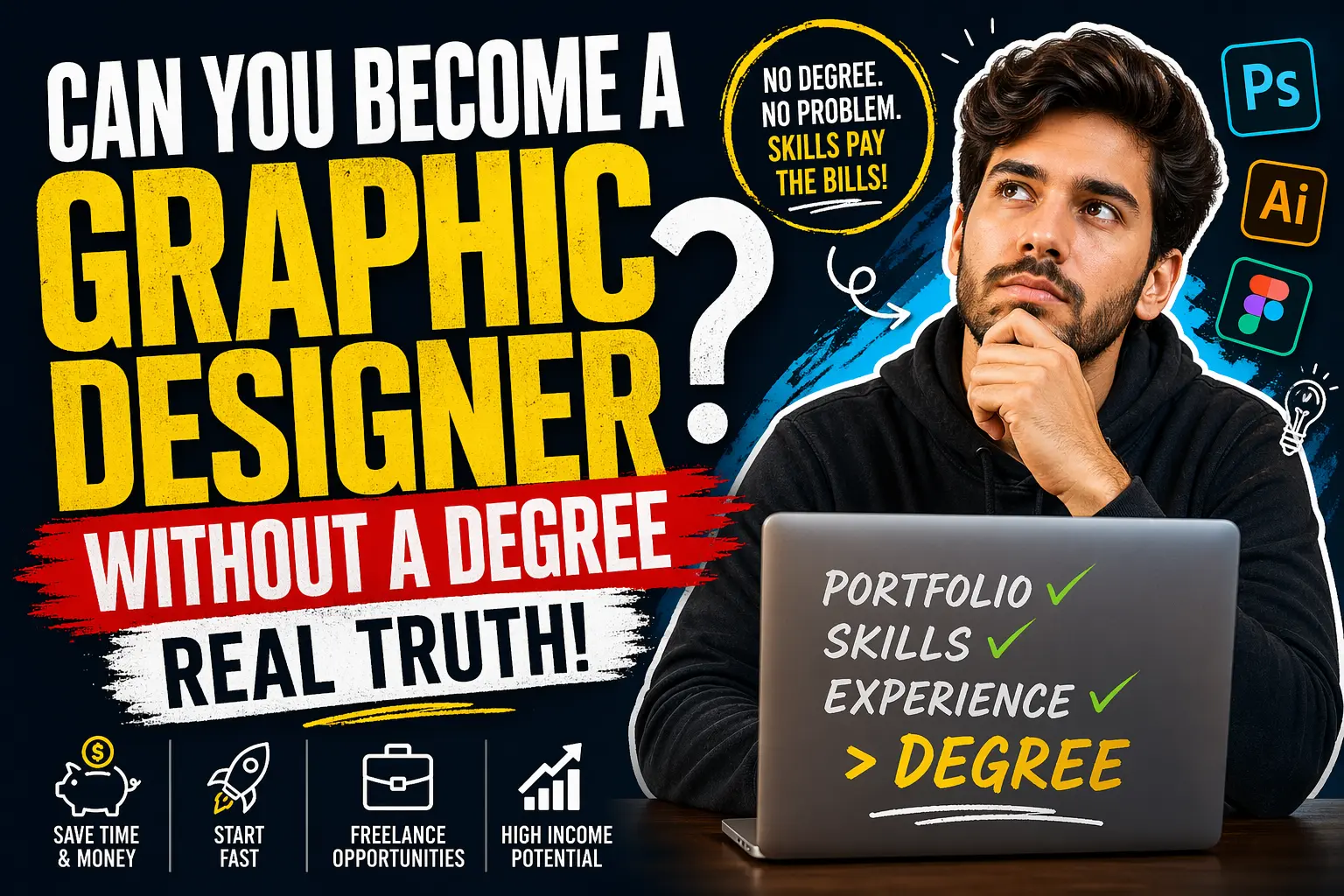
The question “Do I need a degree to become a graphic designer?” is one of the most searched career questions in today’s digital era.
With the rise of freelancing, online learning platforms, and AI-powered design tools, the traditional path of earning a college degree is no longer the only route into creative careers.
But here’s the real truth—not the hype, not the motivational fluff:
👉 Yes, you can absolutely become a graphic designer without a degree.
👉 But it’s not easy, and it’s definitely not for everyone.
This blog will give you a complete, brutally honest breakdown of:
- Whether a degree really matters
- What actually gets you hired
- Skills you must learn
- Step-by-step roadmap
- Real challenges (most blogs hide this)
- Career opportunities & income potential
Let’s dive deep.
1. The Real Truth: Do You Need a Degree?
Short Answer:
👉 No, a degree is NOT mandatory.
According to industry insights, many employers today prioritize:
- Skills
- Portfolio
- Experience
Over formal education.
However, here’s a reality check:
- Around 68% of graphic designers still have a bachelor’s degree
- Many corporate jobs still mention degrees as a requirement
- A degree can make your entry easier
So what’s the truth?
👉 A degree is helpful, but not essential
👉 Your portfolio matters more than your diploma
2. Why Graphic Design Is Different From Other Careers
You cannot become:
- A doctor ❌
- A lawyer ❌
- An engineer (in most cases) ❌
Without a degree.
But graphic design is a skill-based profession, meaning:
👉 If you can design well → you can get paid
Because design is about:
- Creativity
- Problem-solving
- Visual communication
Not about memorizing textbooks.
3. What Employers REALLY Look For
Forget what job descriptions say.
Here’s what actually matters:
1. Portfolio (MOST IMPORTANT)
Your portfolio is your proof of skill.
If your work is good:
👉 Clients don’t care about your degree
2. Practical Skills
Employers want designers who can:
- Create logos
- Design social media posts
- Build branding systems
- Work with design tools
3. Communication Skills
Design is not just art—it’s communication.
4. Real Experience
Even small freelance projects matter.
4. Skills You Must Learn (No Degree Required)
If you skip college, you must compensate with strong skills.
Core Design Skills
- Typography
- Color theory
- Layout & composition
- Branding basics
Software Skills
- Adobe Photoshop
- Adobe Illustrator
- CorelDRAW
- Figma
Modern Skills (Highly Important in 2026)
- UI/UX Design
- Social Media Design
- AI Tools (Midjourney, Canva AI, etc.)
5. Step-by-Step Roadmap (Without Degree)
Step 1: Learn Design Basics (0–2 Months)
Start with:
- YouTube tutorials
- Free courses
- Practice daily
Step 2: Master Tools (2–4 Months)
Focus on:
- One software at a time
- Real project-based learning
Step 3: Build Portfolio (3–6 Months)
Create:
- Fake brand projects
- Logo designs
- Instagram creatives
👉 You don’t need clients initially.
Step 4: Start Freelancing (6+ Months)
Platforms:
- Fiverr
- Upwork
- Freelancer
Step 5: Build Personal Brand
- Instagram design page
- Behance portfolio
- LinkedIn presence
6. How Long Does It Take?
- With degree: ~4 years
- Without degree: 6–12 months (if serious)
BUT…
👉 Only if you practice daily and consistently
7. Advantages of Becoming a Designer Without a Degree
✅ 1. Save Time & Money
No college fees
No student loans
✅ 2. Faster Entry
You can start earning within months.
✅ 3. Freedom to Learn
Learn what actually matters—not theory overload.
✅ 4. Freelancing Opportunities
You don’t need a company to hire you.
8. Disadvantages (Real Truth No One Tells You)
Let’s be honest.
❌ 1. Harder to Get First Job
Some companies filter candidates by degree.
❌ 2. No Structured Learning
You must create your own learning path.
❌ 3. More Self-Discipline Needed
No teacher = no pressure = easy to quit
❌ 4. Strong Competition
You compete with:
- Degree holders
- Experienced designers
9. Freelancing vs Job (Without Degree)
Freelancing (Best Option)
- No degree required
- Portfolio matters
- Global clients
Full-Time Job
- Some companies require degrees
- Portfolio still critical
👉 Best strategy:
Start freelancing → then apply for jobs
10. Real Salary Insights
Average salary:
- Beginner: ₹15,000 – ₹30,000/month
- Intermediate: ₹40,000 – ₹80,000/month
- Advanced: ₹1L+ per month
Globally, median salary is around $61,300/year
11. Is Graphic Design Still a Good Career in 2026?
Yes—and growing.
Graphic design is considered a high-income skill in today’s digital economy.
Reasons:
- Every business needs branding
- Social media demand is exploding
- Digital marketing growth
- Freelance opportunities worldwide
12. Common Myths (Busted)
Myth 1: “You need a degree”
❌ False
Myth 2: “You need expensive software”
❌ False (free tools exist)
Myth 3: “Only talented people succeed”
❌ False (skill > talent)
Myth 4: “Freelancing is easy”
❌ False (requires effort & marketing)
13. Real-Life Industry Insight (From Designers)
From real community discussions:
“The degree helps you get the interview, the portfolio gets you the job.”
This perfectly sums up the reality.
14. Who Should Choose This Path?
Perfect for:
- Self-learners
- Creative individuals
- People who hate traditional education
- Freelancers & entrepreneurs
Not ideal for:
- People needing structured learning
- Those lacking discipline
- People expecting quick success
15. Best Learning Resources
Free:
- YouTube
- Blogs
- Design communities
Paid (Optional):
- Skillshare
- Coursera
- Udemy
16. How to Stand Out Without a Degree
To beat degree holders:
1. Build a killer portfolio
2. Specialize (logo, UI/UX, branding)
3. Learn marketing
4. Use AI tools smartly
5. Build online presence
17. Mistakes to Avoid
❌ Only learning software
❌ Ignoring fundamentals
❌ Copying designs
❌ Not building portfolio
❌ Quitting too early
18. Future of Graphic Design (2026 & Beyond)
- AI will assist, not replace designers
- Demand for creative thinkers will grow
- Hybrid skills (design + marketing) will dominate
Final Verdict: The Real Truth
👉 Yes, you can become a graphic designer without a degree.
👉 But success depends on:
- Your skills
- Your portfolio
- Your consistency
Reality Summary:
| Factor | Degree | No Degree |
|---|---|---|
| Entry speed | Slow | Fast |
| Cost | High | Low |
| Learning | Structured | Self-driven |
| Job chances | Easier | Slightly harder |
| Success factor | Skills | Skills |
👉 In both cases: Skills win.
Conclusion
The world has changed.
Today, companies don’t just ask:
👉 “What degree do you have?”
They ask:
👉 “What can you do?”
If you can design, solve problems, and deliver results—
you can build a successful graphic design career without a degree.
But remember:
⚠️ No degree = No shortcut
⚠️ You must work harder, smarter, and consistently