

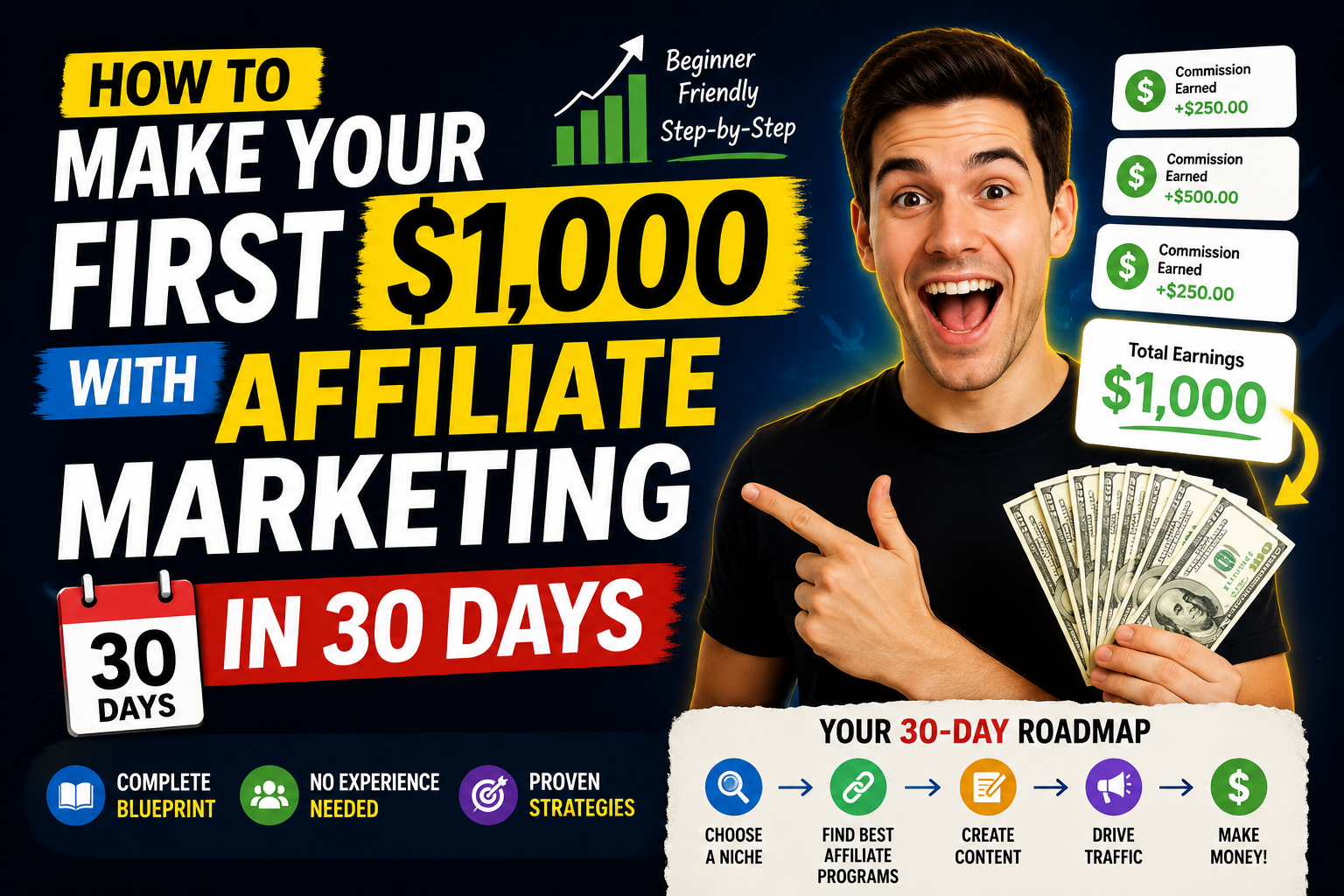
If you have spent any time researching affiliate marketing, you have probably read a dozen articles promising you the “secret” to making money online. Most of them are vague, recycled, and filled with generic advice like “pick a niche you’re passionate about” or “create quality content.” That advice isn’t wrong — it’s just incomplete.
What separates the affiliate marketers who make $1,000 in their first month from the 95% who quit before they see a single sale isn’t luck, talent, or some secret tool nobody else knows about. It’s a system. It’s having a concrete, day-by-day plan that removes guesswork and replaces it with deliberate action.
This guide is that system. It is a 30-day, hour-by-hour roadmap built for beginners who have zero audience, zero authority, and a limited budget — but who are willing to put in focused, consistent work. By the end of this article, you will know exactly what to do on Day 1, what to do on Day 15, and what to do on Day 30 to give yourself the best possible shot at hitting that first $1,000 milestone.
Let’s get started.
What Affiliate Marketing Actually Is (and Isn’t)
Affiliate marketing is a performance-based business model where you earn a commission for promoting another company’s products or services. You share a unique tracking link, and when someone clicks that link and makes a purchase (or completes another action, like signing up for a free trial), you get paid.
Here’s what affiliate marketing is not:
- It is not passive income on Day 1. It becomes semi-passive later, but the first 30 days require active, consistent effort.
- It is not a get-rich-quick scheme. Anyone promising guaranteed results is misleading you.
- It is not just “posting a link and hoping.” Successful affiliates build trust first, then monetize that trust.
Understanding this distinction matters because it shapes your entire strategy. You are not chasing clicks — you are building a small, focused audience that trusts your recommendations enough to act on them. That trust is the actual asset you’re creating in the next 30 days, and the $1,000 is simply the byproduct of that trust being monetized correctly.
The Realistic Math Behind Your First $1,000
Let’s remove the mystery and just do the math, because numbers make a vague goal feel achievable.
Assume you promote a product with a $50 commission per sale. To hit $1,000, you need 20 sales in 30 days — roughly 0.67 sales per day.
Now assume a modest 2% conversion rate on your affiliate link (meaning 2 out of every 100 people who click your link make a purchase). To get 20 sales, you need 1,000 clicks on your affiliate links over the month, or about 33 clicks per day.
That is a genuinely achievable number. It doesn’t require viral content or a massive following — it requires consistent, targeted traffic to content that is genuinely helpful and naturally leads to a recommendation.
Alternatively, if you promote higher-ticket items (software, courses, or high-commission physical products) with a $100+ commission, you’d only need 10 sales, cutting your required traffic roughly in half. This is why niche and product selection — covered next — is arguably the single highest-leverage decision you’ll make in this entire process.
Choosing a Profitable Niche in Under 48 Hours
Most beginners waste weeks agonizing over niche selection. You don’t have weeks — you have 30 days total, so this decision needs to happen fast and be good enough, not perfect.
The Three-Filter Method
Run every niche idea through these three filters:
Filter 1: Buyer Intent. Does this niche have people actively looking to buy something, or are they just browsing for entertainment? Niches like “personal finance,” “productivity software,” “home fitness equipment,” and “pet care products” have strong buyer intent. Niches like “celebrity gossip” or “general motivation” typically don’t convert as well.
Filter 2: Commission Viability. Does the niche have affiliate programs offering commissions of at least $20–$50 per sale, or recurring commissions (subscription-based products are excellent because you get paid every month a customer stays subscribed)?
Filter 3: Content Feasibility. Can you realistically create 15–20 pieces of genuinely useful content about this topic within 30 days, even with limited expertise? If you’d need a PhD to sound credible, pick something else.
Beginner-Friendly Niches With Proven Track Records
- Personal finance and budgeting tools
- Productivity and note-taking software
- Web hosting and website-building tools
- Home fitness and wellness products
- Remote work and freelancing tools
- Pet care and pet products
- Beginner cooking and kitchen gadgets
- Online course platforms and skill-building tools
Pick one. Not two, not three — one. Focus is what compresses your timeline from years down to 30 days.
Selecting the Right Affiliate Programs and Products
Once your niche is locked in, your next task is finding 3–5 affiliate programs to promote. Don’t try to promote 20 different products in your first month; diluted focus produces diluted results.
Where to Find Affiliate Programs
- Affiliate networks such as ShareASale, CJ Affiliate, Impact, and Awin aggregate thousands of programs across every niche imaginable.
- Direct affiliate programs run by SaaS companies (many software tools run their own in-house programs with generous recurring commissions).
- Amazon Associates, useful for physical products, though commission rates are lower (typically 1–10%).
What Makes a Product “Promotable”
Before committing to a product, verify:
- Commission rate and structure (one-time vs. recurring)
- Cookie duration (how long after a click you still get credit for a sale — look for 30+ days)
- Average order value (higher AOV means higher commissions per sale)
- Product reputation (check reviews; promoting a low-quality product destroys trust fast)
- Landing page quality (if the merchant’s own sales page is poorly designed, your conversion rate will suffer no matter how good your content is)
Choose products you would genuinely recommend to a friend. This isn’t just an ethical stance — it’s a practical one. Authentic enthusiasm is nearly impossible to fake in writing, and readers can sense the difference.
Building Your Platform: Website, Social, or Both?
You need somewhere to publish your content and place your affiliate links. Here are your realistic options for a 30-day sprint:
Option A: A Simple Blog/Website
Pros: Full control, builds long-term SEO value, looks more credible to readers and to affiliate program approval teams. Cons: Takes a few hours to set up; SEO traffic takes time to build (though this guide includes workarounds).
Recommended setup: A self-hosted WordPress site with a lightweight theme, or a simpler builder if you want speed over customization. This can realistically be live within half a day.
Option B: Social Media (YouTube Shorts, TikTok, Instagram Reels, Pinterest)
Pros: Zero setup cost, potential for rapid reach, doesn’t require SEO knowledge. Cons: Platform-dependent (algorithm changes can tank reach overnight), less control, and most platforms restrict direct affiliate links in certain placements.
The Recommended Hybrid Approach
For a 30-day sprint, the highest-probability strategy is a hybrid model: a simple website as your “home base” (for credibility, SEO compounding, and a central hub for your links), paired with one social platform where you consistently show up to drive immediate traffic while the website’s organic SEO builds in the background. Pinterest and YouTube Shorts are particularly strong pairings with a blog because they have longer content lifespans than Instagram or TikTok posts.
The Content Engine: What to Create and When
Content is the vehicle that carries your affiliate links to real, interested humans. In 30 days, you don’t need to be a world-class writer — you need to be consistently useful.
The Four Content Types That Convert Best
1. Comparison Content (“Product A vs. Product B”) — These attract people who are already close to a buying decision, making them some of the highest-converting content you can produce.
2. Best-Of Listicles (“7 Best Tools for X in 2026”) — These capture broad search intent and let you naturally include multiple affiliate links.
3. How-To Tutorials — Genuinely solve a problem, and recommend the product as the tool that makes solving it easier.
4. Honest Reviews — Detailed, balanced reviews (including downsides) build enormous trust and consistently outperform overly promotional content.
Content Cadence for 30 Days
A sustainable and effective pace for a solo beginner is:
- 12–15 blog posts or long-form pieces (roughly one every two days)
- 20–30 short social posts repurposed from your long-form content (roughly one per day)
This might sound like a lot, but the key is repurposing. One well-researched blog post can become a Pinterest pin, a YouTube Short script, three Instagram captions, and a Twitter/X thread. Create once, distribute many times.
Driving Traffic Without an Existing Audience
This is where most beginners get stuck. You have great content, but nobody is reading it. Here’s how to fix that fast.
Free Traffic Strategies
- SEO-optimized content: Even without existing domain authority, targeting long-tail, low-competition keywords (phrases with 3–6 words and clear buyer intent) can get you ranking within weeks, not months.
- Pinterest: Massively underrated for affiliate marketing because pins act like evergreen search results rather than disappearing posts.
- Reddit and niche forums: Genuinely helpful participation (never spammy link-dropping) in relevant communities builds credibility and drives curious clicks to your profile or content.
- Quora and answer sites: Answering real questions in your niche with a link to a more detailed resource is a proven, durable traffic source.
- Email list building: Even a small list of 100–200 engaged subscribers can outperform thousands of passive social followers, because you own that channel directly.
Paid Traffic (Optional, for Faster Results)
If you have even a small budget ($100–$300), targeted social media ads or Pinterest ads pointed at a single high-converting piece of content can accelerate your first sales considerably. This is optional, not required — but it can meaningfully compress your timeline if used carefully and tracked closely.
Conversion Optimization: Turning Clicks Into Commissions
Traffic without conversions is wasted effort. Here’s how to make sure the people who do click actually buy.
- Place links contextually, not randomly. A link that appears exactly where a reader has a relevant question converts far better than one dropped at the end of an unrelated paragraph.
- Use clear calls-to-action (“Check current pricing here” performs better than a bare, unexplained hyperlink).
- Be transparent about the affiliate relationship. Disclosure isn’t just a legal requirement in most jurisdictions — transparent creators are consistently trusted more, not less.
- Add urgency and specificity where honest (limited-time discounts, specific use cases, real numbers) rather than vague enthusiasm.
- Optimize for mobile, since a majority of readers will be on phones; broken mobile layouts silently kill conversions.
The Complete 30-Day Action Plan (Day-by-Day)
Week 1: Foundation (Days 1–7)
- Day 1: Finalize your niche using the Three-Filter Method. Write down your “why” to keep yourself accountable.
- Day 2: Research and apply to 5–8 affiliate programs in your niche.
- Day 3: Set up your website (or chosen platform). Install essential plugins/tools.
- Day 4: Keyword research — identify 15–20 long-tail keyword opportunities.
- Day 5: Write and publish your first piece of content (a best-of listicle works well as a strong opener).
- Day 6: Set up your social platform of choice and publish your first three posts.
- Day 7: Review week one, adjust your content calendar for week two.
Week 2: Content Momentum (Days 8–14)
- Days 8–13: Publish one long-form piece every two days (comparison post, tutorial, review), repurposing each into 2–3 social posts.
- Day 14: Analyze early traffic data. Double down on whatever content type is getting the most engagement.
Week 3: Traffic Acceleration (Days 15–21)
- Day 15: Begin active participation in 2–3 relevant forums or communities.
- Day 16–19: Continue content cadence; start answering questions on Quora/Reddit linking back to your best content.
- Day 20: Build a simple lead magnet (checklist, template, or short guide) to start email list collection.
- Day 21: Review analytics — clicks, click-through rate, and any early sales.
Week 4: Optimization and Push (Days 22–30)
- Day 22–25: Update and improve your top 3 highest-traffic posts — stronger CTAs, better link placement, added detail.
- Day 26: Consider a small paid traffic test on your best-converting content if budget allows.
- Day 27–29: Continue consistent publishing and community engagement.
- Day 30: Full review — total traffic, total clicks, total conversions, total revenue. Document what worked to scale in month two.
Tools You Actually Need (and Which Ones to Skip)
Essential:
- A website builder or CMS (WordPress is the industry standard)
- A keyword research tool (even a free-tier version)
- A link management/cloaking tool to track click performance
- An email service provider (many offer free plans up to a few hundred subscribers)
Nice to Have, Not Essential in Month One:
- Paid design software (free tools handle 30-day needs fine)
- Advanced analytics suites (built-in analytics are sufficient at this stage)
- Paid ad platforms (only if budget genuinely allows)
Resist the urge to buy every tool advertised to affiliate marketers. Execution beats accumulation every single time.
Common Mistakes That Kill Momentum
- Chasing too many niches at once. Focus compounds; scattering doesn’t.
- Promoting products you haven’t actually used or researched. Readers can tell, and it damages trust permanently.
- Publishing inconsistently. Algorithms and audiences both reward consistency far more than sporadic bursts of effort.
- Ignoring analytics. If you don’t know which content is working, you can’t do more of it.
- Giving up before Day 30. Most affiliate income compounds — the first sale is always the hardest to get, and momentum builds from there.
Frequently Asked Questions
Is $1,000 in 30 days realistic for a complete beginner?
It’s achievable but not guaranteed — it requires consistent daily action, a smart niche and product choice, and genuine effort on both content and traffic generation. Results vary based on niche competitiveness, time invested, and execution quality.
Do I need a large following to succeed?
No. Many successful affiliate marketers start with zero audience and build momentum through targeted, high-intent content rather than raw follower counts.
How much money do I need to start?
You can start with $0–$50 using free tools and organic traffic strategies. A modest budget accelerates results but isn’t required.
What if I don’t hit $1,000 by Day 30?
Treat it as data, not failure. Most affiliate businesses see their strongest growth in months two and three, once content and trust have had time to compound.
Final Thoughts: What Happens After Day 30
Hitting your first $1,000 isn’t really about the money itself — it’s proof of concept. It proves your niche has demand, your content resonates, and your traffic strategy works. Once you have that proof, scaling becomes a matter of doing more of what’s already working: more content, more traffic channels, possibly more products.
The affiliate marketers who eventually build five- and six-figure businesses aren’t smarter or luckier than you — they simply kept showing up past the point where most people quit. This 30-day blueprint gives you the structure. The consistency is up to you.
Start today. Day 1 begins now.